Monday, December 17, 2007

Cremation 101


In Varanasi, at the 'burning ghats', people are publicly cremated. The rules for cremation are as follows: you can be cremated so long as you are not a child, pregnant woman, leper, or have been bitten by a cobra. Your class decides what type of wood will be used to burn you (sandalwood is for the elite). If you are a young woman, you are draped in red, a young man is draped in white, and old people are covered in gold. The pyres are lit from an "eternal flame"; an area where logs are kept burning 24/7. A holy man will light straw from the flame and bring the burning straw to the pyre. Before lighting, he will walk around the body five times to symbolize the five elements: earth, wind, fire, air, and water. The smoke at the burning ghats is heavy. The ash and embers blow around. You are never quite sure what (or who) you are breathing in, only that you have witnessed something that feels voyeuristic. I am still coming to grips with the notion that I watched a young man, a young woman, and an elder burn before me. I do not know their names or their stories. I only know their class because of the wood that was used.

Monkeys


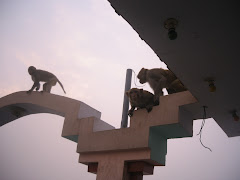
I think back wistfully to the first monkey I saw in India. It was in the distance and I grabbed by camera, zoomed to the max, and got a blurry shot of something that looked like a cat. That was then. Now, they are everywhere. Things cannot be left on balconies, or windows left open, otherwise the mini-humans (or, more appropriately, thieves) will creep away with what belongs to you. Or worse, they will attack. I heard a story of a man getting beaten to the ground and bitten by one of the region's bigger monkeys. Yes, they are cute when they sit with their young strapped to their undersides. They appear harmless as they carefully (almost delicately) root through garbage, but when they beat you up and take your crap, well that's just like New York City in the 80s. And here I am without my mace.

Friday, December 14, 2007

Varanasi


Varanasi, India’s holiest and oldest city, is also septic. The city is built along the Ganges River and is comprised of 80 different ghats (or areas with steps leading into the river). Ancient (feeling) architecture hugs the shoreline while smoke billows from pyres from the cremation ghats. The river, so filthy now, houses those generations past sins. Just imagining the sheer volume of people who come to this river to cleanse themselves of actual or spiritual impurities suffocates me. It grabs hold of my chest like a punch to the solar plexus might leave you gasping for air. But even still, children play in these waters. They still take advantage of what the river is giving them. It has been the most obvious showing of a word so often maligned: Faith.

Wednesday, December 12, 2007

The Hunt for Bhut Jolokia

It is known as the spiciest chili is the world (in fact, Guinness ranked it as such), and it can be found in one area in India. It's apparent white color gives it the nickname "ghost chili;" I just hope it doesn't disappear before I can get to it. Imagine a thumb-sized chili having the same sense of awe and adventure as the Holy Grail.

Monday, December 10, 2007

Nearly honest


There’s a bartender in Patnem name Brahma who left his family a year ago to come southward. He was trained as an electric engineer, but didn’t like spending days in a lab. So he packed up his things and left. All he had was the belief in himself that he was a “people person.” Speaking with him is how I imagine a conversation with Confucious would be. He says things like “There is no profit in lying.” And quickly follows that with “I only lie to my father.” There is humor and sadness is this. Much like how I imagine India to be.

Medicine Man


This is Ayrgun. He is a medicine man from Karnataka. He "diagnosed" my health and considered me to be of "medium-bad" health. I asked what that meant and he said I had too much fire. Then he promised to cure me for $40 USD with an herbal mix that I would take 3 times a day for 2 months. I said I couldn't carry around all of that powder with me while I traveled. So he shrugged and said, "ok, 1 month and you get less medium."
Ayurvedic Massage


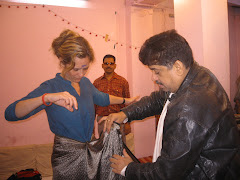
I was a little scared. First of all, it is a massage I could hardly pronounce, secondly, they wanted me to strip and lie down on a wooden table that resembled a torture device (I was given a loin cloth for cover). Next I knew, two people were rubbing and pulling me simultaneously. This, to help circulation as the belief is that poor circulation is the root to poor health. Herb-scented hot oil is poured over your body and as you get tugged, you also start to slide around the table (thankfully there were no splinters!). What amazed me most was that the lead masseuse (the one who sets the pace for the other masseuse) knew within 5 minutes that I had problems with the right side of my body. Sure the bowling ball-sized knots probably gave it away, but he was able to narrow down that my problems emanated from my cervical spine. For those of you who know me well, this is the moment you should go “ah hah!” For those of you just getting to know me, your “ah hah” will come.
The Un-India


Patnem is south of Goa and is the place to go when you want to be in India, but feel like you are someplace else. Here drinking is allowed, as are tank tops and even bikinis. It is rebuilt every year after the monsoon season shreds the make-shift huts apart. Everything is make-shift. Mattresses are yoga pads, toilets are holes, but there is nothing like showering with a bucket of cold water under the stars with the occasional frog hopping through.

Saturday, December 8, 2007

Ingenious


Kids in Mumbai seem to spend much of their free time roaming through the streets of Chor Bazaar with home made metal detectors. It is basically a stick with a magnet attached to one end that they drag through the littered dusty streets. After just a few minutes of watching a group of three young boys, they all came up lucky. I recall being given a store made metal detector to help pass the time on the beach as a 7 year old. I have no idea what it cost, but I am pretty sure the junk I found never made up for it. Home made has its advantages.

India's rail system

It is said that to truly understand a culture, you have t spend time on the rails. With this in mind, I navigated my way through the Victoria Terminus to get a ticket for a 12 hour train ride southward to Goa. Upon my arrival, a man was being run through the terminal on a stretcher. He had apparently fallen off the train and was run over. I assume this as I cannot fathom another reason why his leg would have been bloodied and dissected. (apologies for those of you eating while reading). I was told that this happens quite frequently as people cram themselves on to the commuter trains. While I had hoped to experience the rails the way the locals do, I also decided it was probably best for me to get a reserved seat so that I wouldn't have to fight to stay on the train. After getting on three of the wrong lines, I finally got my ticket to Goa. 6am departure time. This is clearly not a vacation.

Afghanistan revisited?

I thought I had already gone to the amputee capital of the world when I was in Kabul, but Mumbai is giving that metropolis a run for its money. As I approached Chor Bazaar, I was greeted by a triple amputee on a roller board. His one arm moved him along, and once he gathered enough velocity, he aimed himself for me and was able to wrap his one and only arm around mine. I understand why Mother Teresa spent so much time in these parts. There is heartache a plenty.

Wednesday, December 5, 2007

No Thank You necessary

I was out to dinner with a seemingly polite, young Indian man named Amand and he let me in on a little secret. Apparently "please" and "thank you" are considered condescending in India. I didn't believe it at first until I watched how the locals ordered their food and never used the common pleasantries. Could this be? Miss Manners must have never travelled to India. ((A note from linguist Noam Chomsky: politeness is actually built in to verb endings.))  

Welcome to Mumbai

You know you have reached Mumbai when the sounds of life are downed out by a relentless orchestra of car horns.   You know you have reached the city's vibrant center when the aroma is that of an flooded sewer. You know you are a tourist when the written cost of something is "X", but you get charged "X" plus "Y" and "Z".  But I am here in India's southern capital and couldn't be happier. Plus, on my very first night, I was approached for a massage. What I couldn't discern; however, as I stood on the sandy stretch of Chowpatty Beach, was whether I was being asked to give or receive one. In any event, I kept my hands to myself.

Friday, August 31, 2007

Things that make you go ewww ....


On the boat ride to Vung Tau, a popular beach resort south of HoChi Minh City, I stumbled upon this notice to passengers. The boat is very old and I think the English signage is a throw back to when the American War (what the call the Vietnam War) was happening. One part struck me as odd. It made me wonder if what happened in Vung Tau stayed in Vung Tau.

Green Guys


No, they are not environmentalists. They are street crossers. They assist the elderly, the young, and the tourist in negotiating HoChi Minh City’s traffic patterns. These green guys generally hang out around hotels and major points of interest in HCMC (so “tourist walking” is where the big business is), and they wear all green to indicate that they are “official.” But who are these green gods? They are from the city’s Youth Volunteer Brigade, and they know what it takes to cross the street safely. So the next time your travels take you to Saigon/HoChi Minh City, don’t let someone dressed in another color walk you across the street ... who knows where you’ll end up if you do.

Thursday, August 30, 2007

Desperately Seeking Noam Chomsky

I am really trying to communicate in my version of Vietnamese. It hasn’t been going too well. A sample:
ME: (in Vietnamese) “How do you say ‘lemon’?”
Waiter: (in English) “Lemon?”
ME: (in Vietnamese) “Yes, how do you say lemon?”
Waiter: “Lemon.”

Wednesday, August 29, 2007

The Rice Fields


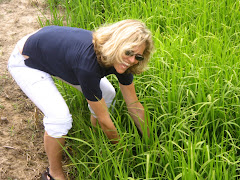
The next time you sit in front of a bowl of rice, I ask that you give a silent shout out to the people who farmed it. I tried to pretend I was one with the paddies, but the walk out through the the swampy rice stew alone tired me out. Plus there is that fear that you might stumble upon some one's ankle, hacked off in their frenzy to cut the rice down for milling. The poorer farmers do not have the electric miller that you see in these pictures; they hack down the rice and carry it to ground where they beat it with rocks to get the grains out. And the process I just explained is just one in a series. There's the planting of the seeds, the agitating of the seeds (I think that means they tease them), the milling, the husking, and the polishing (for white rice). So if you don't want to eat brown rice for health reasons, do it so that these good people have do one less thing to worry about. Oh behalf of all freelance rice farmers, I thank you.

Tuesday, August 28, 2007

Meet Linh


Pham Thi Thuy Linh is 13 years old and is waiting for an operation that will remove the hump from her back. She is scared of the operation, but she understands that weight needs to be taken off her spine so that she can live without pain. Most days the pain is so bad, she cannot walk. Linh is probably a victim of Agent Orange, but getting designated as such is more difficult now that the US and Vietnam have mended fences. Clearly it is not in the US’s interest to admit their wartime chemical continues to plague this country, and Vietnam doesn’t want to push the issue.
Linh was born without arms and has beautiful teeth. She is religious about her oral hygiene, and holds her toothbrush with her foot. She opens doors by using her head and chin and wears only elastic pants so that she can shimmy up and down bathroom walls to use the toilet. Linh lives in a “village” created by the Tu Du Hospital. She is one of 60 children who were born with defects and abandoned by their families. But she doesn’t want to go home even if her parents came back for her because she is happy and she loves her brothers and sisters. Linh spends most of her free time listening to pop music; she says she doesn’t dance … at least not yet.

Monday, August 27, 2007

My Chuchi Experience


Enough as been written about the Chuchi Tunnels so instead of regurgitating the history behind the vast and complex VC tunnel system, I thought I'd give you the highlights from my experience. First off, you need to understand that the Vietnamese have no problem in stating the obvious. If you are plump, you will be called “big man” or “big lady,” so hope they don’t characterize you this way. Before getting to the tunnels, everyone in my pack was lined up, and the guide went down the row pointing to people on which tunnel they could see. Tunnels have been recreated a littler wider for westerners to act like VC. Down the line they went: “big tunnel .. big tunnel .. little tunnel”; the closer they got to me, the more I wanted to be labeled “little tunnel.”
They pointed to me, sent me in with the smaller people, explained that we would be going down 8 meters into the ground and tunneling across 100 meters. There were “air holes” at 50 meters and the guide smiled and said “no problem, let’s go.” I was trying my best to remember metric conversions .. wondering how far and long would I be underground? What was this about an air hole? Does this mean I can’t breath before then? Suddenly I wanted to be fat.
The photos are of me getting in to the tunnel (you cover up with a door the way the VC did), and tunneling.

Unesco Schmunesco


Halong Bay (in the northeast of Vietnam) has been designated a UNESCO site. It is an area littered with limestone jetties/mini islands. Most of these spots have caves and through those caves there are lagoons. Parts of it are breathtaking, but then there is the part that most of the day tourists see. Gone for them are the emerald waters that Halong Bay boasts of in its brochures, instead its main part .. the one most visitors now see, is littered with junk boats which have now turned the waters into a dozen shades of brown. Ten years ago thee were 40 junk boats (flat-ish bottomed, wooden boats that chug their ways through the bay allowing visitors to overnight in a relatively tranquil state). Now there are over 400 of these boats. It is not the boats that are ruining it, but the disorganization of it all. Most of us adopt a “we want it when we want it” mentality, but that wicked side of our psyches should not be catered to. Amidst the frenzy, there is a certain amount of order. If only that order was applied to restricting of number of boats out at one time, or the locations where they could putter, this would remain a UNESCO site for much longer. Note: you can see Halong Bay in its glory if you spend two – three days there (which I recommend). The photos are of the conjestion at the docks and a more traditional Halong Bay beauty shot.